Showing posts with label Greece. Show all posts

Tuesday, 7 July 2015

ABC Wednesday, Z for Zeus


We thank Denise Nesbitt, who created ABC, and we must thank Roger too for the weekly job to find  ten bloggers for each of the ABC Team members  to visit and to read their posts. For more interesting ABC posts click on the logo in the sidebar . This week we are looking for words  beginning with Z


Having been in Greece, made me wonder what the ancient Greeks believed , and then it is pretty obvious that Zeus is the person to go with the letter  Z! Who was Zeus?


Wikipedia:
"Zeus (English pronunciation: /ˈzʲuːs/, z(y)oos),  is the god of sky and thunder and the ruler of the Olympians of Mount Olympus. The name Zeus is cognate with the first element of Roman Jupiter, and Zeus and Jupiter became closely identified with each other.
Zeus is the child of Cronus and Rhea, and the youngest of his siblings. In most traditions he is married to Hera, although, at the oracle of Dodona, his consort is Dione: according to the Iliad, he is the father of Aphrodite by Dione. He is known for his erotic escapades. These resulted in many godly and heroic offspring, including Athena, Apollo, Artemis, Hermes, Persephone (by Demeter), Dionysus, Perseus, Heracles, Helen of Troy, Minos, and the Muses (by Mnemosyne); by Hera, he is usually said to have fathered Ares, Hebe and Hephaestus."

Well all those names are only interesting to those people among us who like to study the classical history. I was not  classically educated, so I find it difficult to remember all those gods and their names. Paul made it easier to the people of his time to tell them about the one God we believe in. 
Nevertheless, we couldn't escape Zeus. We met him in Delphi and later his statue in the National Archaeological Museum. We saw the ruins of the temples dedicated to Athena, Apollo and Aphrodite. He was also the lover of Europe.

Here follows the legend of  Europe and the bull.

 From  Encyclopedia of Greek Mythology: Europa - Mythweb

 Europa was gathering wildflowers in a seaside meadow when she came upon a beautiful white bull. This bull was uncommonly gentle and did not inspire fear. Decking its horns with flowers, Europa was at length emboldened to climb upon its back. Whereupon the bull - actually the god Zeus in disguise - took off at a trot and dove into the sea. Europa was carried off to the island of Crete, where she became the mother of King Minos.


Tuesday, 19 May 2015

ABC Wednesday, Greece, S for Stele

These are steles which we saw in Greece.
Wikipedia:"A stele (plural steles is a stone or wooden slab, generally taller than it is wide, erected as a monument, very often for funerary or commemorative purposes. Stelae may be used for government notices or as territorial markers to mark borders or delineate land ownership. They very often have texts and may have decoration. This ornamentation may be inscribed, carved in relief (bas, high, etc.), or painted onto the slab. Traditional Western gravestones are technically stelae, but are very rarely described by the term


With thanks to Denise Nesbitt,  who created ABC, and Roger, who took over from her. For more interesting ABC posts click on the logo in the sidebar. This week we are looking for words beginning with S.

Tuesday, 28 April 2015

ABC Wednesday, P for Philippi

With thanks to Denise Nesbitt,  who created ABC, and Roger, who took over from her. For more interesting ABC posts click on the logo in the sidebar. This week we are looking for words beginning with P.


This is supposed to be the place where Lydia was baptized


Paul in Philippi
Philippi apparently had only a small number of Jewish inhabitants and no synagogue. Consequently Shabbat worship was held outside the city on the Gangitis River.  Here Paul met a group of women to whom he preached the gospel.  Lydia, a merchant trading purple cloth, believed Paul's message and was baptized with members of her household.  Subsequently Paul went and lived at her home.

Philippi is a mixure of many cultures : The Greek and the  Roman cultures are the most important

Founded in the 4th c. B.C. and renamed after King Philip of Macedon, Philippi was an important outpost on the Egnation Way.   


Excavations
Archaeological work
 has revealed a large
 and well-preserved 
forum, a theater,
 the alleged jail
 of Paul and several
 Byzantine churches,
 including one of the
 earliest churches
 known in Greece.  
The number of 
churches
 in the city in the 
Byzantine period
 indicate Philippi's
 importance to 
 Christians at this 
time.
 A series of 
earthquakes 
apparently destroyed
 many of the 
buildings
 and probably
 contributed to 
the city's decline.


Egnatian Way
The Via Egnatia was built beginning in 145 BC and at its greatest extent connected Byzantium with the Adriatic ports.  This route was Rome's primary artery to the east and Philippi was an important outpost along the road.  The Egnatian Way made it easier for Rome to move troops throughout the empire and it was the route that Paul traveled on from Neapolis to Philippi, Amphipolis, Apollonia and Thessalonica.
Via Egnatia next to Philippi forum from east

Philippi, alleged place of Paul's prison
Philippian Jail
This traditional place of
Paul and Silas's 
imprisonment is of
 dubious authenticity,
 but it remembers the 
attack on these men
 and their subsequent
 flogging and 
imprisonment.  In the
 course of the night,
 a violent earthquake
 shook the prison and 
the jailer feared that
 all might have escaped. 
 After learning that 
none had fled, 
the Philippian jailer put
 his faith in Christ and 
was baptized with his 
family.

Latrines
Public bathrooms were not uncommon in ancient Roman cities, but this one is a good illustration for Paul's reference to scubalon, or human waste. 
Roman latrines
Related Websites
Philippi (Hellenic Ministry of Culture) Highlights the site's history, excavations,
and important monuments. Hosted by the government of Greece.
Mission in Philippi (The Unbound Bible) Briefly recounts the history of Philippi
 and the biblical events that happened there in Acts 16.
Philippi (Christian Travel Study Programs) Summarizes the city's history,
 biblical significance, and excavations.

The Battle of Philippi: The Battle that Changed the Course of Western Civilization
 (Life and Land Seminars) Gordon Franz details the battle in which Mark Antony
 and Octavian defeated Brutus and Cassius.


Tuesday, 21 April 2015

ABC Wednesday, O for Origin of the Delphic Oracle


With thanks to Denise Nesbitt,  who created ABC, and Roger, who took over from her. For more interesting ABC posts click on the logo in the sidebar. This week we are looking for words beginning with O.


The earliest account of the origin of the Delphic oracle is provided in the Homeric Hymn to Delphic Apollo, which recent scholarship dates within a narrow range, ca. 580–570 BC.

Delphi


Wikipedia:

Apollo spoke through his oracle: the sibyl or priestess of the oracle at Delphi was known as the Pythia; she had to be an older woman of blameless life chosen from among the peasants of the area. She sat on a tripod seat over an opening in the earth. When Apollo slew Python, its body fell into this fissure, according to legend, and fumes arose from its decomposing body. Intoxicated by the vapors, the Pythia would fall into a trance, allowing Apollo to possess her spirit. In this state she prophesied. It has been speculated that a gas high in ethylene, known to produce violent trances, came out of this opening, though this theory remains debatable

One theory states that a goat herder fed his flocks on Parnassus. It happened one day the goats started playing with great agility upon nearing a chasm in the rock; the goat herd noticing this held his head over the chasm causing the fumes to go to his brain; throwing him into a strange trance.

While in a trance the Pythia "raved" – probably a form of ecstatic speech – and her ravings were "translated" by the priests of the temple into elegant hexameters. People consulted the Delphic oracle on everything from important matters of public policy to personal affairs. The oracle could not be consulted during the winter months, for this was traditionally the time when Apollo would live among the Hyperboreans. Dionysus would inhabit the temple during his absence.


Tuesday, 14 April 2015

ABC Wednesday, N for National Archaeological Museum.

We didn't want to miss the National Archaeological Museum in Athens. Although this was not a place where Paul was present, but it showed us what articles were used at his time.


The National Archaeological Museum  in Athens houses some of the most important artifacts from a variety of archaeological locations around Greece from prehistory to late antiquity. It is considered one of the greatest museums in the world and contains the richest collection of artifacts from Greek antiquity worldwide.


Wikipedia:Gorgons were  popular images in Greek mythology, appearing in the earliest of written records of Ancient Greek religious beliefs such as those of Homer, which may date to as early as 1194–1184 BC. Because of their legendary and powerful gaze that could turn one to stone, images of the Gorgons were put upon objects and buildings for protection. An image of a Gorgon holds the primary location at the pediment of the temple at Corfu, which is the oldest stone pediment in Greece, and is dated to c. 600 BC.


Gorgon

  Mycenaean civilization originated and evolved from the society and culture of the Early and Middle Helladic periods in mainland Greece. It emerged in circa 1600 BC when Helladic culture in mainland Greece was transformed under influences from Minoan Crete.

Here some examples of Mycenaean Art.


 Other artefacts such as jewellery.


 Ostracism. An interesting voting system!!


With thanks to Denise Nesbitt,  who created ABC, and Roger, who took over from her. For more interesting ABC posts click on the logo in the sidebar. This week we are looking for words beginning with N


Tuesday, 7 April 2015

ABC Wednesday, M for Meteora


By enlarging the photos you see more details. 

 Nearer to Heaven.....


 High on the steep rocks of  the Meteora area there are some monasteries and a nunnery.In the middle ages there were more of these buildings but now there are 6 monasteries left.

There were no stairs at the time to climb the rocks. Whatever the monks needed  was put in a big net and the contents were pulled up. Even the monks were pulled up by this net.  It was not until 1922 that stairs were hewn in the rocks, so that pelgrims could safely climb to the monasteries.  I still don't know how they got enough water for bathing and washing clothes.


Being nearer to God....


Wikipedia:"The Metéora meaning "middle of the sky", "suspended in the air" or "in the heavens above", is one of the largest and most important complexes of Greek Orthodox monasteries in Greece, second only to Mount Athos."
Originally there were 21 monasteries on the rocks of Meteora, but six of them are left. The six monasteries still function today.

Monastery of Varlaam


This post is dedicated to the letter M, and we thank Mrs. Denise Nesbitt for creating this meme. You can participate in this game. You only should find a photo or a subject in poetry or the name of a famous person....beginning with M


We visited the Holy Monastery of the great Meteoron( The Transfiguration of Our Saviour.)


Monastery of the Holy Trinity        

Tuesday, 31 March 2015

ABC Wednesday, Greece, L for Lonely Life at the Top


Kalambaka

On our way to the Meteora we stopped at Kalambaka for lunch. We were fascinated by the high and strangely shaped mountains. I had  never seen anything like these rocks.

I shall write more about the Meteora in my post of the letter M.

Living conditions are very complicated on these strange and steep mountains. I'll write more about this in my next post.


 High on the tops of these mountains, monasteries were built.  People live here their, sometimes, lonely lives.


Kalambaka


This post is dedicated to the letter L, and we thank Mrs. Denise Nesbitt for creating this meme. You can participate in this game. You only should find a photo or a subject in poetry or the name of a famous person....beginning with L.


And... please refer to Mrs. Nesbitt and the ABC on Wednesday. You can also put the logo in your sidebar or post. If you have any problems please contact one of the team members.

Tuesday, 24 March 2015

ABC Wednesday, Greece, K for Käisariani

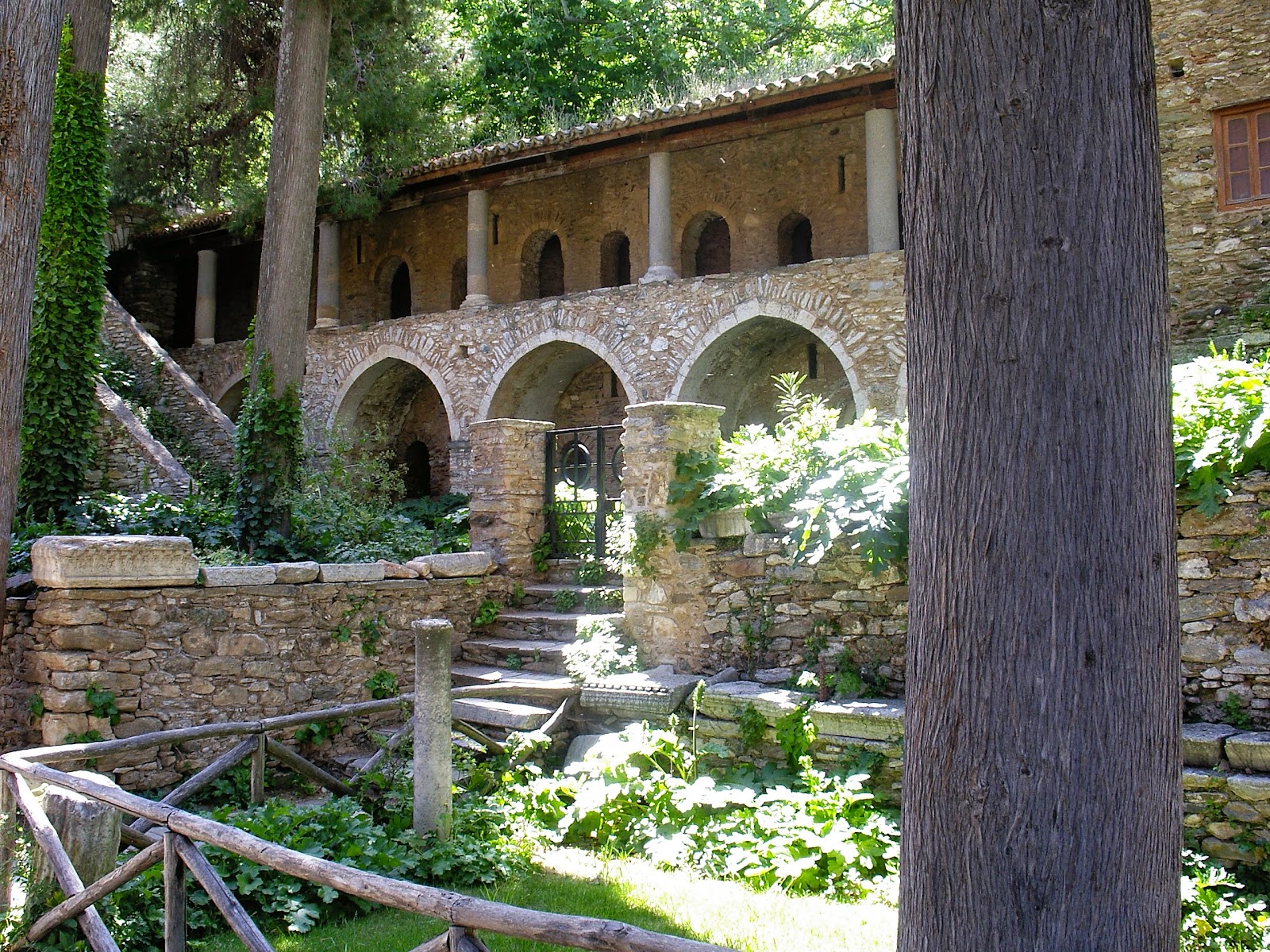
One of the most beautiful and serene places of all we saw was in my opinion the monastry of Käisariani, which was founded  in the 11th century.

In 1458 when Sultan Mehmet II conquered  Athens, this monastery was exempt from taxation, because the abbot had given the keys of the city to the sultan. This caused a period of great prosperity, which lasted till 1792, when the monastery lost all its privileges and fell into decay. The buildings were restored in 1956.


This was a wonderful place to stay , but we had to go on, for there is so much to see in Greece!

We thank Mrs Denise Nesbith who invented this meme . We arrived at K in the 16th round.


Interior beautifully decorated.

 Restoration on the frescoes can only be done in a short time of the year, due to the short period of dry weather and the right temperature


This post is dedicated to the letter K, and we thank Mrs. Denise Nesbitt for creating this meme. You can participate in this game. You  should only find a photo or a subject in poetry or the name of a famous person....beginning with K And...please  don't forget to refer to ABC on Wednesday.