Showing posts with label Great Britain. Show all posts
Tuesday, 20 December 2016
Tuesday, 4 October 2016
ABC Wednesday, M for Memorials
Memorials
When we were in England this year we stayed in Withern- Alford. The first day we were met in Hull by my brother-in-law. It was a long trip to his house in Withern, but he still had some time to show us the airport for the gliding club in Lincolnshire . We heard that this was an important airfield during WW II. From this place the Lancaster bombers flew to Germany to drop their bombs on the German cities. There are several memorials to remind us of this period. It is remarkable to see and read how young these pilots and other crew members were.
We saw a painting of one of the bombers, made by one of the members of the gliding club.
Please enlarge these photos, in order to see how young the pilots, who were killed,
were.
|
Several of these planes never returned and were shot down while flying over the Netherlands..This painting was painted by one of the members of the gliding club.
With thanks to Denise Nesbitt, who created ABC.For more interesting ABC posts click on the logo in the sidebar.
This week we are looking for words beginning with M.
Monday, 8 August 2016
Our World Tuesday, ABC Wednesday, E for Eye of London

Opposite the Houses of Parliament

In the factory of Hollandia in the Netherlands.

Opposite the Houses of Parliament

In the factory of Hollandia in the Netherlands.
After 2000 the Eye of London became a landmark of the City of London. At that time I happened to teach English to a group of adults,of whom several men were involved in the construction of this enormous wheel. Every week they informed me about its progress. I even got newspapers with the latest news. Enough material for my lessons.
Wikipedia says:
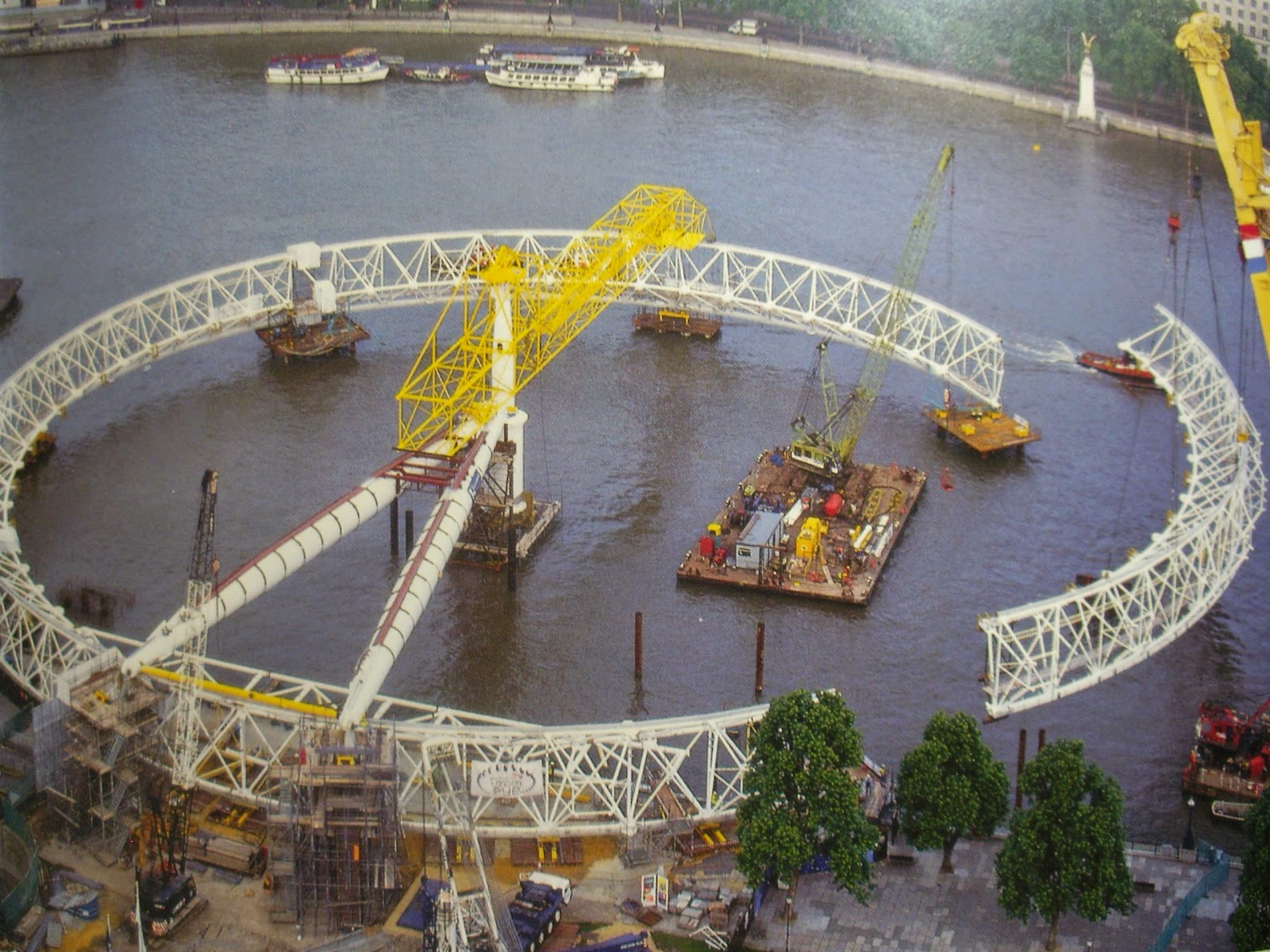
"The wheel was constructed in sections which were floated up the Thames on barges and assembled lying flat on piled platforms in the river. Once the wheel was complete it was lifted into an upright position by a strand jack system made by Enerpac. It was first raised at 2 degrees per hour until it reached 65 degrees, then left in that position for a week while engineers prepared for the second phase of the lift. The project was European with major components coming from six countries: the steel was supplied from the UK and fabricated in the Netherlands by the Dutch company Hollandia, the cables came from Italy, the bearings came from Germany (FAG/Schaeffler Group), the spindle and hub were cast in the Czech Republic, the capsules were made by Poma in France (and the glass for these came from Italy), and the electrical components from the UK.[27]"
On our last day in Great Britain in 2007, we were in London, where we made a short trip on the Thames. Here I saw for the first time the Millenium Wheel or The Eye of London. The guide told us that the construction of the Eye of London was sponsored by British Airways. I was waiting to hear that he would tell where it was constructed, but in vain..
It was made in Holland at the factory where my eldest daughter was a draughtswoman, who had actually drawn a small part of the Wheel.At that time we were very anxious to see if it could be constructed at all.
It was designed by David Marks and Julia Barfield, who were architects.
A well known Japanese company was first asked to do the construction, but they turned it down. Too difficult!! Then Hollandia in the Netherlands offered to do the job, after the engineers studied long and hard on the project.They even made a model of it. It was going to be the biggest wheel in the world. With a splendid ceremony the green light was given on January, 28th, 1999.The work had to be finished before the beginning of the new millenium.It was an enormous challenge.
The wheel was finished in December 1999 and opened on 31st December.
![]() |
This photo shows the assembly of the last sectionon a special platform in the river. |
The above photo shows one of the four rim sections, which had to be taken to London from Holland. The right photo shows the first section arriving in London.
The London Eye stands 135 metres (443 ft) high on the western end of Jubilee Gardens, on the South Bank of the River Thames in London, England, between Westminster and Hungerford Bridges.
With thanks to Denise Nesbitt, who created ABC. For more interesting ABC posts click on the logo in the sidebar This week we are looking for words beginning with E.
Welcome to Our World Tuesday! This meme continues in memory of the work of Klaus Peter, whose "that's My World" brought people together from around the world every Monday to share the wonders therein--big and small.Please click on our logo for "Our World Tuesday" in the sidebar. Thank you Team of O.W.T
And then one of the cables broke in an attempt to hoist the wheel up,
but a couple of weeks later the wheel was successfully erected. It was a
great moment.
Labels: ABC Wednesday, Great Britain, E, London, Hollandia
In the meantime the Eye is not any longer the biggest wheel in the world!
This is what Wikipedia says:
- 2000: the London Eye, in London, UK, is 135 metres (443 ft) tall. Although officially opened on December 31, 1999, it did not open to the public until March 2000, because of technical problems.
- 2006: the Star of Nanchang, in Nanchang, Jiangxi Province, China, opened for business in May and is 160 metres (525 ft) tall.
- 2008: the Singapore Flyer, in Singapore, is 165 metres (541 ft) tall. It started rotating on February 11 and officially opened to the public on March 1, 2008.
- 2014: the High Roller, in Las Vegas, Nevada, US, is 167.6 metres (550 ft) tall. It opened to the public on March 31, 2014, and is currently the world's tallest Ferris wheel.[25]
Labels:
ABC Wednesday,
E,
England,
Great Britain,
London,
Our World Tuesday.
Tuesday, 15 March 2016
ABC Wednesday, J, Jersey, John Nettles

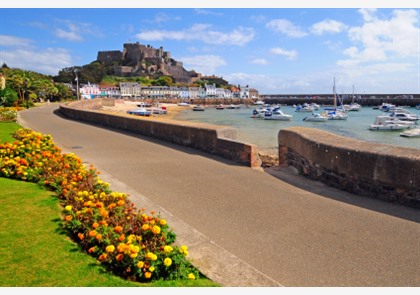
Mont Orgueil was built in the 13th century to protect JERSEY from French invasion.
Mont Orgueil (Jerriais: 'Mount Pride' or 'Haughty Mount') is a castle in Jersey that overlooks the harbour of Gorey. It is also called Gorey Castle by English-speakers, and lé Vièr Châté (the Old Castle) by Jèrriais-speakers.
.
The island of JERSEY and the other Channel Islands represent the last remnants of the medieval Duchy of Normandy that held sway in both France and England. JERSEY lies in the Bay of Mont St Michel and is the largest of the Channel Islands. It has enjoyed self-government since the division of the Duchy of Normandy in 1204.
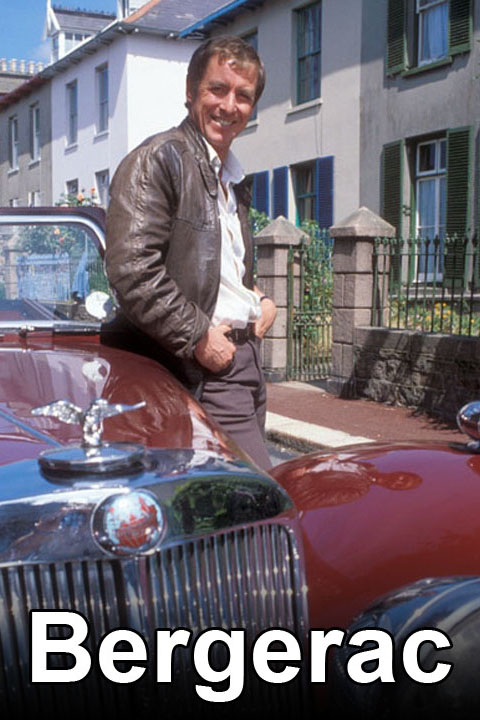
I have never been on JERSEY, but I always watched the TV series Bergerac, which was a British television show set on JERSEY. JOHN Nettles (who later starred in the British crime series Midsomer Murders as Tom Barnaby) played the part of JIM Bergerac.
JERSEY has been an island for approximately 8,000 years . The earliest evidence of human activity in the island dates to about 250,000 years ago when hunters used the caves at La Cotte de St Brelade as a base for hunting mammoth. The Neolithic period is marked by the building of the ritual burial sites known as dolmens. Archaeological evidence shows that there were trading links with Brittany and the south coast of England during this time.

Although part of the Roman world, we know very little about the island until the 11th century. The Channel Islands, then called the Lenur Islands, were occupied by the Britons during their migration to Brittany (5th-6th century).Tradition has it that it was Saint Helier from Tongeren in modern-day Belgium who first brought Christianity to the Island in the 6th century, and Charlemagne sent his emissary to the island in 803.
Normans
The island took the name JERSEY as a result of Viking activity in the area between the 9th and 10th centuries. The Channel Islands remained politically linked to Brittany until 933 when William Longsword, Duke of Normandy seized the Cotentin and the islands and added them to his domain; in 1066 Duke William II of Normandy defeated Harold at Hastings to become king of England; however, he continued to rule his French possessions as a separate entity.
With thanks to Denise Nesbitt, who created ABC.For more interesting ABC posts click on the logo in the sidebar . This week we are looking for words beginning with J.
Labels:
ABC Wednesday,
Great Britain,
History,
J,
Jersey
Tuesday, 23 February 2016
ABC Wednesday, G for Guernsey
| Outside our unit in Quernsey |
In May 2006, my sister, her husband and I went to spend a week's holiday on Guernsey.We walked a lot and spoke to many islanders, who told us interesting facts about Guernsey. The island is small but has a long and eventful history.
Walking in the forest we enjoyed the sight of the blue bells |
Although Guernsey is geographically closer to the Normandy coast than to the south coast of England it is a dependency of the British Crown.
So why does Guernsey remain loyal to Britain, rather than France her closest neighbour?
It all began in 933 AD when the Channel Islands became part of the Norman Realm. In 1066, the Duke of Normandy landed his army in Sussex and became William I of England. The Channel Islands, however, remained part of the Duchy of Normandy and continued to be governed as such.
When Continental Normandy was lost in 1204 the Channel Islands remained loyal to the King of England as the King promised to rule the islands as though he was the Duke of Normandy (i.e. observing the Duchy’s laws, customs and liberties). This arrangement has been confirmed in charters of successive sovereigns that have secured for the islands their own judiciaries and freedom from the process of the English Courts. Indeed the Islands are independent in all matters with the exception of international representation and defence for which the United Kingdom is responsible.
The islands were the focal point of strife between England and France for many years due to their allegiance to England. At times, the French raided the islands and gained temporary footholds and, as a consequence, there are castles and fortresses around Guernsey that were originally built as a protection against invaders.
With thanks to Denise Nesbitt, who created ABC.For more interesting ABC posts click on the logo in the sidebar . This week we are looking for words beginning with G.
Tuesday, 20 October 2015
ABC Wednesday,O of OK

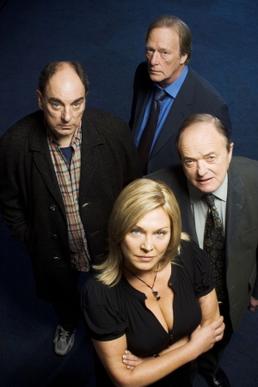
| New Tricks is a British comedy-drama that follows the work of the fictional Unsolved Crime and Open Case Squad (UCOS) of the Metropolitan Police Service. Led by Detective Superintendent Sandra Pullman, it is made up of retired police officers who have been recruited to reinvestigate unsolved crimes. The series title is taken from the proverb "You can't teach an old dog new tricks" | |
|---|---|
These retired policemen and woman might be old, but they still do their job well and sometimes even better than the original police officer who did the investigation when the crime had happened. |
|
| Wikipedia: | |
| "OK" (also spelled "okay", "ok", or "O.K.") is a word denoting approval, acceptance, agreement, assent, or acknowledgment. "OK", as an adjective, can also express acknowledgment without approval. "OK" has frequently turned up as a loanword in many other languages. As an adjective, "OK" means "adequate", "acceptable" ("this is OK to send out"), "mediocre" often in contrast to "good" ("the food was OK"); it also functions as an adverb in this sense. As an interjection, it can denote compliance ("OK, I will do that"), or agreement ("OK, that is fine"). As a verb and noun it means "assent" ("the boss OKed the purchase" and "the boss gave his OK to the purchase"). As a versatile discourse marker (or back-channeling item), it can also be used with appropriate voice tone to show doubt or to seek confirmation ("OK?" or "Is that OK?"). |
|
Subscribe to:
Posts (Atom)