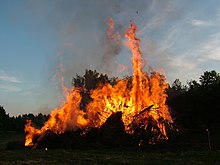
The lighting of bonfires by the ancient Celts may have influenced the lighting of bonfires on All Hallows' Eve
Wikipedia says:
"Today's Halloween customs are thought to have been influenced by folk customs and beliefs from the
Celtic-speaking countries, some of which have pagan roots, and others which may be rooted in
Celtic Christianity.
Historian Nicholas Rogers, exploring the origins of Halloween, notes
that while "some folklorists have detected its origins in the Roman
feast of
Pomona, the goddess of fruits and seeds, or in the
festival of the dead called
Parentalia, it is more typically linked to the Celtic festival of
Samhain", which comes from the
Old Irish for "summer's end"
Samhain (pronounced
SAH-win or
SOW-in) was the first and most important of the four
quarter days in the medieval
Gaelic calendar and was celebrated in
Ireland,
Scotland and the
Isle of Man.It was held on or about October 31 – November 1 and kindred festivals were held at the same time of year by the
Brittonic Celts; for example
Calan Gaeaf (in
Wales),
Kalan Gwav (in
Cornwall) and Kalan Goañv (in
Brittany).
Samhain and Calan Gaeaf are mentioned in some of the earliest Irish and
Welsh literature. The names have been used by historians to refer to
Celtic Halloween customs up until the 19th century,
and are still the Gaelic and Welsh names for Halloween."
Interesting, isn't it? I don't understand why "Halloween" is not really very popular in the Netherlands.The poster shows an invitation to join a Halloween party in a park in Rotterdam. It should be attractive to children, I think. On the poster it says "Griezelavonden"(=Blood-curdling evenings) on Wednesday. And it says:" Iedere dag extra enge activiteiten", meaning:"Every day extra weird activities."
 |
Happy Halloween
With thanks to Denise Nesbitt, who created ABC.For more interesting ABC posts click on the logo in the sidebar.
This week we are looking for words beginning with P.
Words in this post beginning with P: Poster, Plaswijckpark, Pagan, Pomona, Parentalia.
|


